Protecting Your Gallbladder on a GLP-1: The Dietary Levers Nobody Talks About
The conversation around GLP-1 medications is loud right now — protein, muscle, bone density, hair, "food noise." All worth talking about. But there's one piece that keeps getting left out, and it's one of the few where what you put on your plate genuinely moves the needle: your gallbladder.
If you're losing weight on semaglutide (Wegovy, Ozempic) or tirzepatide (Mounjaro, Zepbound), here's the honest version of the gallbladder story — what the risk actually is, why it happens, and the small, food-first moves that lower it. The reassuring twist: those moves are the opposite of crash dieting. They ask you to eat, not to cut.

Lizzie Clarke, Anchor & Apex clinical nutrition/eating disorder recovery
The protective move on a GLP-1 isn't to eat less — it's to keep nourishing yourself, thoughtfully.
First, the honest headline
GLP-1 medications work, and they're a legitimate treatment. They also cause the kind of fast weight loss that has been linked to gallstones for decades — and the medication itself nudges the gallbladder in the same direction. So gallbladder trouble is a real, known thing to keep an eye on while the weight is coming off.
And here's the part almost nobody says out loud: the things that protect your gallbladder during rapid weight loss are the opposite of dieting harder. They are keep some fat in your meals and keep eating regularly — even when the medication has erased your appetite. Eating almost nothing is part of what lets gallstones form. So the protective move is to keep nourishing yourself, thoughtfully.
That's the whole spirit of this article. Not another diet. A few steady moves that ask you to take care of yourself.
Why the gallbladder gets stressed during GLP-1 weight loss
Your gallbladder is a small pouch tucked under your liver. It stores bile and squeezes it into your gut to help digest fat. During GLP-1 weight loss, two things put it under a little strain — and they stack on top of each other.
Fast weight loss changes your bile
When weight comes off quickly — from any cause — two changes happen at once. Your liver sends extra cholesterol into the bile, which can push bile past the point where it can keep that cholesterol dissolved. And the gallbladder starts to empty less often and less completely. Bile that sits still and is rich in cholesterol is precisely the setup that lets cholesterol stones form. This is the same reason crash diets and skipped meals have always carried a gallstone risk — GLP-1s just produce that fast loss reliably.
The medication slows the gallbladder a little, too
Separate from the weight loss, GLP-1 medications appear to make the gallbladder contract more slowly on their own. You can't change that part with food — but it's exactly why the dietary levers are more worth doing, not less.
How big is the risk, honestly?
It's worth seeing both numbers, because the relative and the absolute tell different stories.
A large review pooled 76 clinical trials and over 100,000 people and found that those on a GLP-1 had a meaningfully higher rate of gallbladder and biliary problems — about a 37% higher relative risk overall, with the signal stronger at higher doses, with longer use, and when the medication was used for weight loss rather than diabetes.
But in absolute terms, the numbers stayed small. In the semaglutide weight-management trials, gallbladder-related events occurred in roughly 2 out of 100 people on the medication, compared with about 1 out of 100 on placebo.
So: a real increase that's worth protecting against — and not a reason to panic or to abandon a medication that's helping you. Hold both facts at once.
The dietary levers that actually matter
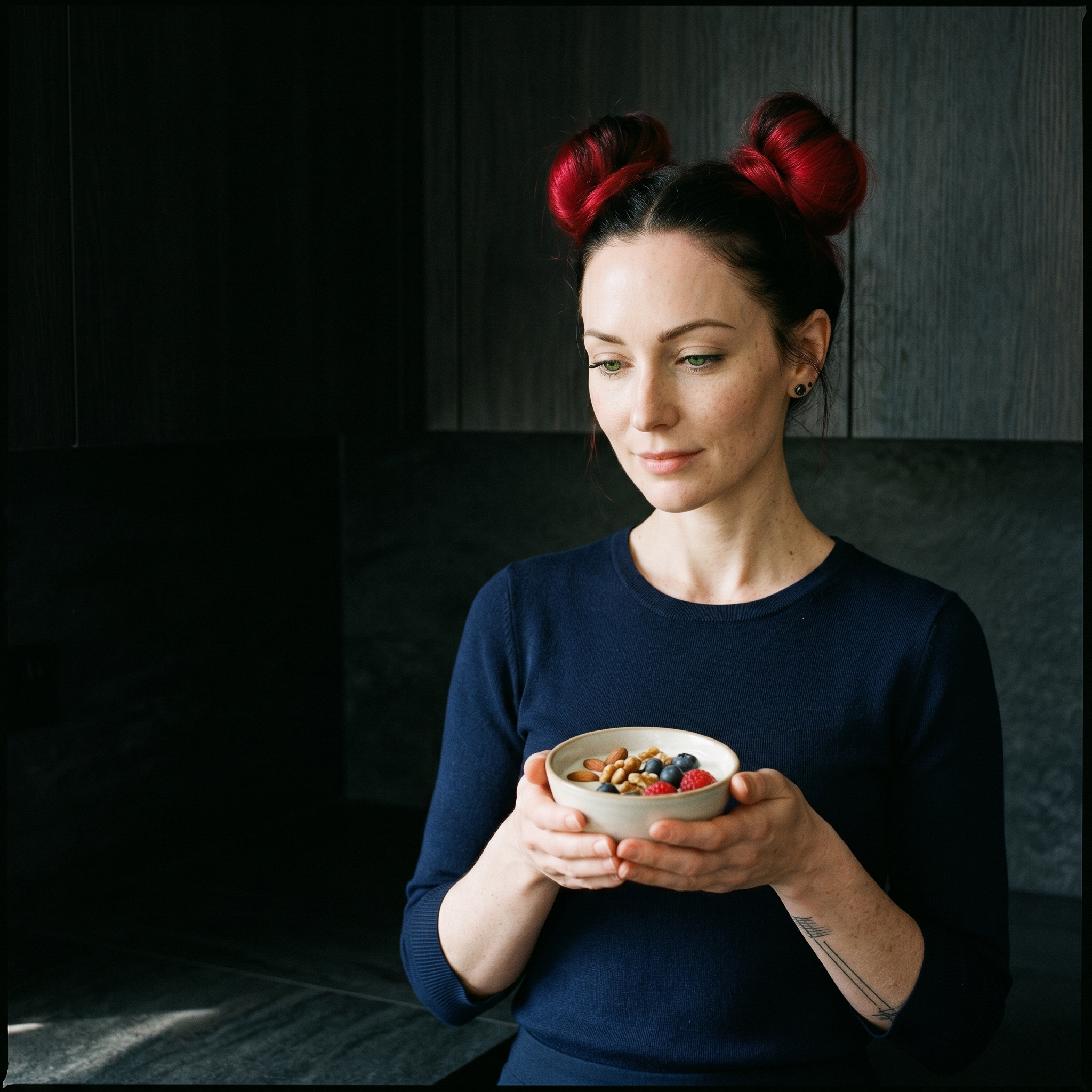
A small bowl of nuts and berries — a simple source of fat at a meal
A handful of nuts and a little fruit — the kind of small, fat-containing meal that keeps the gallbladder emptying.
This is the part worth screenshotting.
Lever 1: Keep a little fat in every meal
This is the big one. Your gallbladder only squeezes and empties when it gets a signal — and dietary fat is that signal. Fat in a meal triggers a hormone called cholecystokinin (CCK), which tells the gallbladder to contract. Eat a meal with no fat at all, and the gallbladder mostly sits still and the bile stagnates. Keep some fat in your meals, and it keeps emptying the way it should.
Researchers studying rapid weight loss were so struck by this that they titled a study "use it (fat) to lose it (well)" — in their trial, people losing weight on a higher-fat plan kept their gallbladders emptying and formed fewer stones than those on the very-low-fat version.
You don't need much, and you don't need to weigh anything. Just include a source of fat at each meal:
- A handful of nuts or a spoonful of nut butter
- Olive oil or avocado on your vegetables or toast
- Eggs, fish, or a little cheese
- Full-fat yogurt rather than fat-free
The meal to watch for is the all-lean-protein, plain-vegetables, zero-fat one. That's the meal that lets your gallbladder go quiet.
Lever 2: Keep a gentle rhythm of regular meals
GLP-1s can flatten hunger so thoroughly that a whole day passes on a few bites. If that's you, know that it's the medication doing its job — not a willpower problem. But meal rhythm still matters for your gallbladder, because long stretches without eating mean it never gets a reason to empty, and the bile inside concentrates. Skipped meals and all-day fasts are textbook gallstone setups.
The fix is gentle and, frankly, freeing: eat something at regular times, even when hunger isn't there to remind you. The meals can be small — small is completely fine. Your gallbladder just needs the rhythm. A simple little meal a few times a day protects it better than one large meal after a long gap.
Lever 3: Let the loss be steady, not stacked with extra deprivation
Gallstone risk climbs the faster weight comes off. On a GLP-1, the pace is largely set by your medication and your prescriber — and that's not something to fight by eating even less. The point is simply: don't pile a crash diet on top of a medication that's already doing the work. Eating enough — Levers 1 and 2 — is how you make the weight loss gentler on your gallbladder. Adding a second layer of restriction does the opposite.
Lever 4: The sensible basics — water and fiber
Stay reasonably hydrated, and include some fiber — vegetables, fruit, whole grains, beans. A regular, fiber-containing eating pattern keeps your digestion (gallbladder included) moving. These are supportive helpers rather than miracle cures, but they're easy and they fit the same theme: regular, real meals.
One thing to ask about — not self-manage
For people losing weight very rapidly, some clinicians prescribe ursodeoxycholic acid, a medication that lowers gallstone risk during fast weight loss. This is a prescriber decision, not something to manage on your own — but it's worth raising at your next visit if rapid loss is part of your plan.
Know the warning signs
Most gallstones never cause symptoms. But because a GLP-1 raises the odds, it helps to know what a gallbladder problem feels like. Contact your clinician promptly if you notice:
- Steady pain in the upper-right or upper-middle belly, often after meals, lasting an hour or more
- Pain spreading to your right shoulder or between the shoulder blades
- Nausea or vomiting with the pain
- Fever or chills alongside belly pain (possible infection — more urgent)
- Yellow skin or eyes, dark urine, or pale stools (possible blocked duct — urgent)
This isn't a "wait it out" list. If these appear, reach out to your clinician or seek care.
Already had your gallbladder removed?
Then gallstone prevention isn't your concern anymore. The only small note: without a gallbladder, bile drips into your gut continuously, so a single very fatty meal can sometimes cause loose stools or urgency. The easy adjustment is to spread fat across your meals rather than loading it into one. The "eat regularly, eat enough" message still serves you.
The bottom line
The way you protect your gallbladder on a GLP-1 is by eating — regularly, and with some fat in your meals — not by eating less. The medication makes it easy to go long stretches without eating, and those long gaps are part of the problem. So consider this permission, backed by the evidence: nourish yourself through the weight loss, keep your meals real and regular, and you've handled the biggest lever you have.
And keep it in proportion. This is one small thing to do well, not a reason for worry. Your medication is doing its job — this is simply how you take good care of yourself while it does.
This article is patient education from the Anchor & Apex clinical team, not individual medical advice. If you have questions about how this applies to you, talk with your clinician.
References
- He L, et al. Association of GLP-1 Receptor Agonist Use With Risk of Gallbladder and Biliary Diseases: A Systematic Review and Meta-analysis of Randomized Clinical Trials. JAMA Intern Med. 2022;182(5):513–519. PMID 35344001. doi:10.1001/jamainternmed.2022.0338
- Festi D, et al. Gallbladder motility and gallstone formation in obese patients following very low calorie diets. Use it (fat) to lose it (well). Int J Obes Relat Metab Disord. 1998;22(6):592–600. PMID 9665682
- Role of nutrient fat and cholecystokinin in regulation of gallbladder emptying in man. Dig Dis Sci. 1995. PMID 7895538
- Gallbladder contraction: effects of fatty meals and cholecystokinin. Radiology. 1985. PMID 3898222
- Gebhard RL, et al. The role of gallbladder emptying in gallstone formation during diet-induced rapid weight loss. Hepatology. 1996;24(3):544–548
- Johansson K, et al. Risk of symptomatic gallstones and cholecystectomy after a very-low-calorie diet or low-calorie diet in a commercial weight loss program. Int J Obes. 2014;38(2):279–284
- NIDDK — Dieting & Gallstones. National Institute of Diabetes and Digestive and Kidney Diseases.