Is Soy Safe in Menopause? The Phytoestrogen Myth, Calmly Answered
If you've been anywhere near a menopause forum or a wellness feed lately, soy has probably reached you wrapped in two opposite stories. One says it's dangerous — that the "phytoestrogens" in tofu feed breast cancer. The other says it's a remedy — that soy will quiet your hot flashes the way hormones do. Both are everywhere, and both overshoot. The honest version is calmer, and we think it's more useful: soy is a safe, nutritious food — not a threat, and not a cure. Let's walk through what the research actually shows.

Soy is a safe, nutritious food — not a threat, and not a cure.
First, what "phytoestrogen" really means
Soy foods — tofu, tempeh, edamame, soymilk, miso — contain compounds called isoflavones, mainly genistein and daidzein. These are phytoestrogens: plant compounds loosely shaped like the estrogen your body makes. That word "estrogen" is where the worry starts, but the way they behave is where the story gets reassuring.
Isoflavones are not the same as human estrogen. They bind estrogen receptors weakly, and they prefer a particular receptor type — beta receptors — that, in breast tissue, often produces a calming, anti-estrogen-like effect rather than a stimulating one. So "plant estrogen" sounds alarming, but it acts very differently from the real hormone.
There's also a personal wrinkle. About a quarter of people in Western countries — and a higher share in parts of Asia — carry gut bacteria that convert daidzein into a stronger compound called equol. These "equol producers" tend to get a bit more out of soy, which is one reason studies and individual experiences vary so much.
The fear: does soy feed breast cancer?
This is the worry that keeps people away from tofu, so it deserves a direct answer: the human evidence doesn't support it.
The fear came from early animal studies. Mice given purified, high-dose soy compounds showed more growth of estrogen-sensitive tumors. That was a legitimate reason for scientists to look closely — but mice metabolize these compounds differently than people do, and a concentrated dose in a lab is nothing like eating a bowl of edamame.
When researchers studied actual women eating actual soy foods, the picture reversed. Large cohort studies following thousands of breast cancer survivors found that women who ate the most soy had no increase in risk — and, if anything, lower rates of recurrence and death. Meta-analyses pooling the trials reached the same conclusion. Major cancer authorities, including the American Cancer Society and the American Institute for Cancer Research, have reviewed the full body of evidence and agree: soy foods are safe for women, including breast cancer survivors and those with estrogen-receptor-positive disease.
For women on endocrine therapy such as tamoxifen, the evidence on soy foods shows no harm and a possible benefit. The one genuine open question is about high-dose isolated isoflavone supplements during active treatment — which is a different thing from food, and something we'll come back to.
The hope: will soy fix my hot flashes?
Maybe a little, for some women — and that's the honest version.
Reviews of the research suggest soy isoflavones can produce a modest reduction in how often and how intensely hot flashes hit. But three things keep it from being a true fix. The effect is small. It builds slowly, over weeks, rather than working right away. And it's inconsistent — noticeably helpful for some women and not at all for others, with equol producers tending to respond better. Because of that, leading menopause organizations don't recommend soy as a treatment for hot flashes.
So if you enjoy soy and find it takes the edge off, that's a nice bonus. But if hot flashes are genuinely disrupting your life, soy isn't the lever to lean on. That's a conversation worth having with a clinician who can talk through options that reliably help.
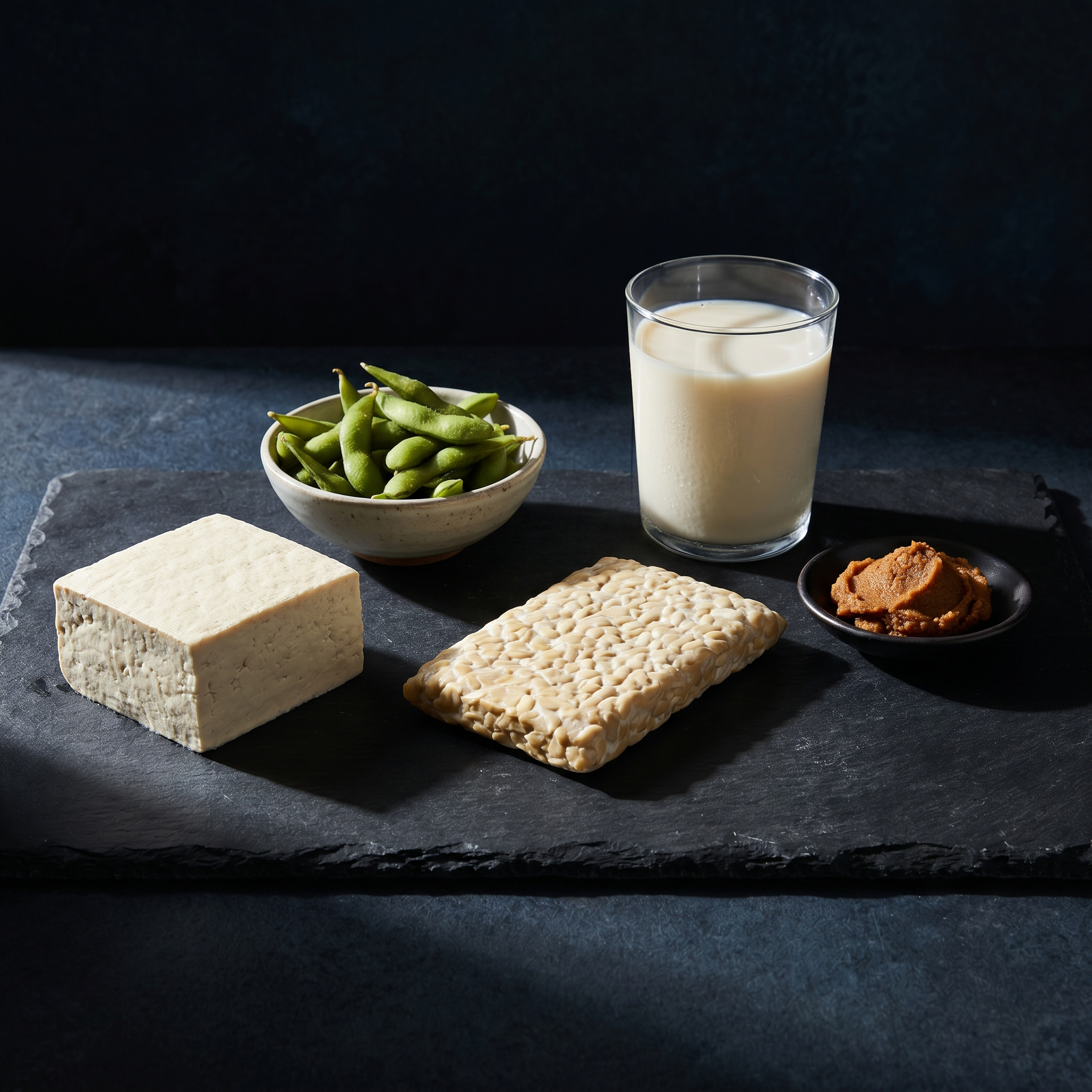
Whole soy foods are the forms studied in the research and endorsed as safe — not isolated isoflavone pills.
Whole foods vs. supplements: the difference that matters
Here's a distinction that resolves a lot of the confusion. Almost everything reassuring above is about whole, traditional soy foods — tofu, tempeh, edamame, soymilk, miso. These are the forms eaten in soy-consuming cultures, the forms studied in the research, and the forms that nutrition and cancer authorities endorse as safe.
Isolated isoflavone supplements — pills and powders that concentrate the active compounds far beyond what food provides — are where genuine uncertainty still lives, especially at high doses. The simple, evidence-aligned takeaway: get your soy from food, not from a supplement bottle. You don't need the pills, and the food is where the strong safety record is.
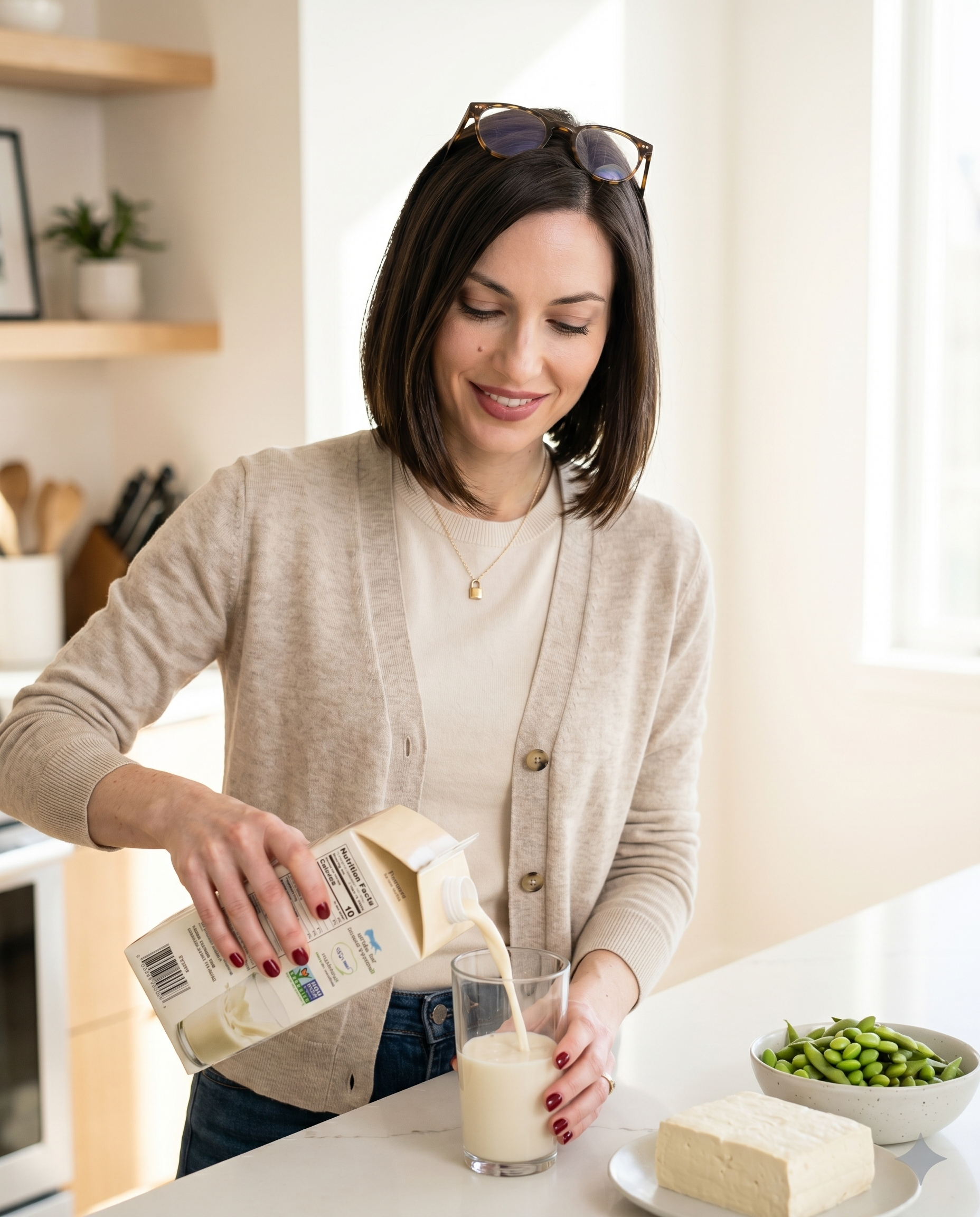
A glass of soymilk, a bowl of edamame, a serving of tofu — worked into how you already eat, no targets required.
How to actually use soy in menopause
The practical part is refreshingly simple.
- Amount: People in soy-eating cultures typically have a few servings a day. You don't need a target. A serving of tofu, a glass of soymilk, or a bowl of edamame worked into how you already eat is plenty — and entirely your call.
- Thyroid medication: You don't have to avoid soy. Just take levothyroxine on an empty stomach and keep soy foods (and any soy supplement) about four hours apart, so soy doesn't interfere with absorption. In people with normal thyroid function and adequate iodine, soy foods don't cause thyroid problems.
- It's protein, too: Soy is one of the more complete plant proteins, which makes it genuinely useful in midlife, when protein and muscle matter more.
How we think about this at Anchor & Apex
Soy is a perfect example of why we don't trade in scary versions or magical ones. The wellness internet loves a villain and loves a miracle, and midlife women get sold both about the same food. Our job is to give you the true version, which here is also the freeing one: a nutritious, protein-rich food has been studied extensively and comes out safe — and you can enjoy it without assigning it powers it doesn't have.
That's the all-foods-fit idea in practice. Soy doesn't need to earn its place by curing anything or by clearing a fear test. It's food. Good food, actually.
The bottom line
Soy has spent years caught between two exaggerations — feared as a danger, sold as a fix. The truth is calmer and more freeing than either: soy is a safe, nourishing food you can enjoy in menopause without worry. It won't feed cancer, and it likely won't cure your hot flashes — and it doesn't need to do either to deserve a spot on your plate. Build your menopause nutrition around the basics that genuinely matter, bring specific questions to a clinician who knows your story, and let tofu stay.
References
Evidence retrieved from PubMed (NCBI) and cancer-nutrition position statements.
- Shu XO, Zheng Y, Cai H, et al. Soy food intake and breast cancer survival. JAMA. 2009;302(22):2437–2443. PMID 19996398; doi:10.1001/jama.2009.1783.
- Nechuta SJ, Caan BJ, Chen WY, et al. Soy food intake after diagnosis of breast cancer and survival. Am J Clin Nutr. 2012;96(1):123–132. PMID 22648714; doi:10.3945/ajcn.112.035972.
- Trock BJ, Hilakivi-Clarke L, Clarke R. Meta-analysis of soy intake and breast cancer risk. J Natl Cancer Inst. 2006;98(7):459–471. PMID 16595782; doi:10.1093/jnci/djj102.
- Qiu S, Jiang C. Soy and isoflavones consumption and breast cancer survival and recurrence: a systematic review and meta-analysis. Eur J Nutr. 2019;58(8):3079–3090. PMID 30382332; doi:10.1007/s00394-018-1853-4.
- Kang X, Zhang Q, Wang S, et al. Effect of soy isoflavones on breast cancer recurrence and death for patients receiving adjuvant endocrine therapy. CMAJ. 2010;182(17):1857–1862. PMID 20956506; doi:10.1503/cmaj.091298.
- Rock CL, Thomson CA, Sullivan KR, et al. American Cancer Society nutrition and physical activity guideline for cancer survivors. CA Cancer J Clin. 2022;72(3):230–262. PMID 35294043; doi:10.3322/caac.21719.
- American Institute for Cancer Research / World Cancer Research Fund. Soy and breast cancer (position statement). AICR, accessed 2026-05-26. aicr.org.
- Taku K, Melby MK, Kronenberg F, et al. Extracted or synthesized soybean isoflavones reduce menopausal hot flash frequency and severity. Menopause. 2012;19(7):776–790. PMID 22433977; doi:10.1097/gme.0b013e3182410159.
- Franco OH, Chowdhury R, Troup J, et al. Use of plant-based therapies and menopausal symptoms. JAMA. 2016;315(23):2554–2563. PMID 27327802; doi:10.1001/jama.2016.8012.
- Shufelt CL, et al. (North American Menopause Society Advisory Panel). The 2023 nonhormone therapy position statement of The North American Menopause Society. Menopause. 2023;30(6):573–590. PMID 37252752; doi:10.1097/GME.0000000000002200.
- Messina M, Redmond G. Effects of soy protein and soybean isoflavones on thyroid function. Thyroid. 2006;16(3):249–258. PMID 16571087; doi:10.1089/thy.2006.16.249.
- Otun J, Sahebkar A, Östlundh L, et al. Systematic review and meta-analysis on the effect of soy on thyroid function. Sci Rep. 2019;9(1):3964. PMID 30850697; doi:10.1038/s41598-019-40647-x.
- Setchell KDR, Cole SJ. Method of defining equol-producer status and its frequency among vegetarians. J Nutr. 2006;136(8):2188–2193. PMID 16857839; doi:10.1093/jn/136.8.2188.
This article is general education, not individual medical advice.